

Resources
Articles
Practical guides and industry updates to help your organization stay secure and compliant in a digital-first world.

The Ultimate Guide to GDPR
The Ultimate Guide to GDPR
The General Data Protection Regulation, a landmark legislation that revolutionized data privacy regulations worldwide. If you're wondering what GDPR is, how it came to be, and whether it affects your business in the US, you've come to the right place. Let's embark on a journey through the intricacies of GDPR and explore how it impacts businesses globally.
What is GDPR?
GDPR stands for General Data Protection Regulation. Enforced in May 2018, GDPR is a set of regulations designed to safeguard the personal data of individuals within the European Union (EU) and the European Economic Area (EEA). It empowers individuals with greater control over their personal data while imposing strict obligations on organizations that collect, process, or store such data.
Overview and History of GDPR
The genesis of GDPR traces back to concerns over data privacy and security in the digital age. With the exponential growth of online transactions and the proliferation of data breaches, the need for a robust regulatory framework became evident. The European Union responded by crafting GDPR, a comprehensive legislation aimed at harmonizing data protection laws across its member states.
Does GDPR Apply to Companies in the US?
Contrary to popular belief, GDPR isn't limited to EU-based businesses. Its extraterritorial reach extends to any organization that processes the personal data of EU residents, regardless of its physical location. This means that if your company deals with EU customers' data, GDPR compliance is non-negotiable.
The Material Scope
GDPR applies to the processing of personal data, which includes any information relating to an identified or identifiable individual. This encompasses a broad range of data, from names and addresses to online identifiers and genetic information.
The Territorial Scope
Even if your company operates outside the EU, GDPR applies if you offer goods or services to EU residents or monitor their behavior. In essence, if your business targets EU consumers or tracks their online activities, GDPR compliance is obligatory.
What Are the Data Subject Rights of GDPR?
One of the cornerstones of GDPR is the empowerment of data subjects, i.e., individuals whose personal data is processed. GDPR grants them several rights, including:
- Right to Access: Individuals can request access to their personal data and information about how it's processed.
- Right to Rectification: Data subjects can rectify inaccuracies in their personal data.
- Right to Erasure: Also known as the "Right to be Forgotten," individuals can request the deletion of their data under certain circumstances.
- Right to Data Portability: Data subjects have the right to receive their personal data in a commonly used format for easy transfer between controllers.
- Right to Object: Individuals can object to the processing of their personal data for direct marketing or legitimate interests.
- Right to Restriction of Processing: Data subjects can request the restriction of processing their personal data under specific conditions.
How Johanson Group Helps with GDPR Compliance
Navigating the complexities of GDPR compliance can be daunting for businesses of all sizes. That's where Johanson Group steps in. With our expertise in data protection and regulatory compliance, we offer comprehensive solutions to ensure your business adheres to GDPR requirements.
From Gap Analysis to Data Protection Impact Assessments (DPIA) and Data Protector Assessments, we provide tailored services to identify vulnerabilities, assess risks, and implement robust data protection measures. With Johanson Group by your side, you can navigate the GDPR maze with confidence and safeguard your customers' trust.
GDPR isn't just a regulatory hurdle; it's a testament to the growing importance of data privacy in the digital era. By understanding its implications and partnering with experts like Johanson Group, businesses can turn GDPR compliance into a competitive advantage and build a foundation of trust with their customers.

ISO 27001 vs ISO 27002: What’s the Difference?
ISO 27001 vs ISO 27002: What’s the Difference?
In the dynamic landscape of cybersecurity and data management, adhering to international standards is paramount. Among the most prominent standards established by the International Organization of Standardization (ISO) are ISO/IEC 27001 and ISO 27002, which serve as pillars for establishing robust information security management systems (ISMS). But what sets them apart, and why are they crucial for businesses? Let's delve into the nuances of ISO 27001 and ISO 27002 to unravel their significance.
What is ISO/IEC 27001?
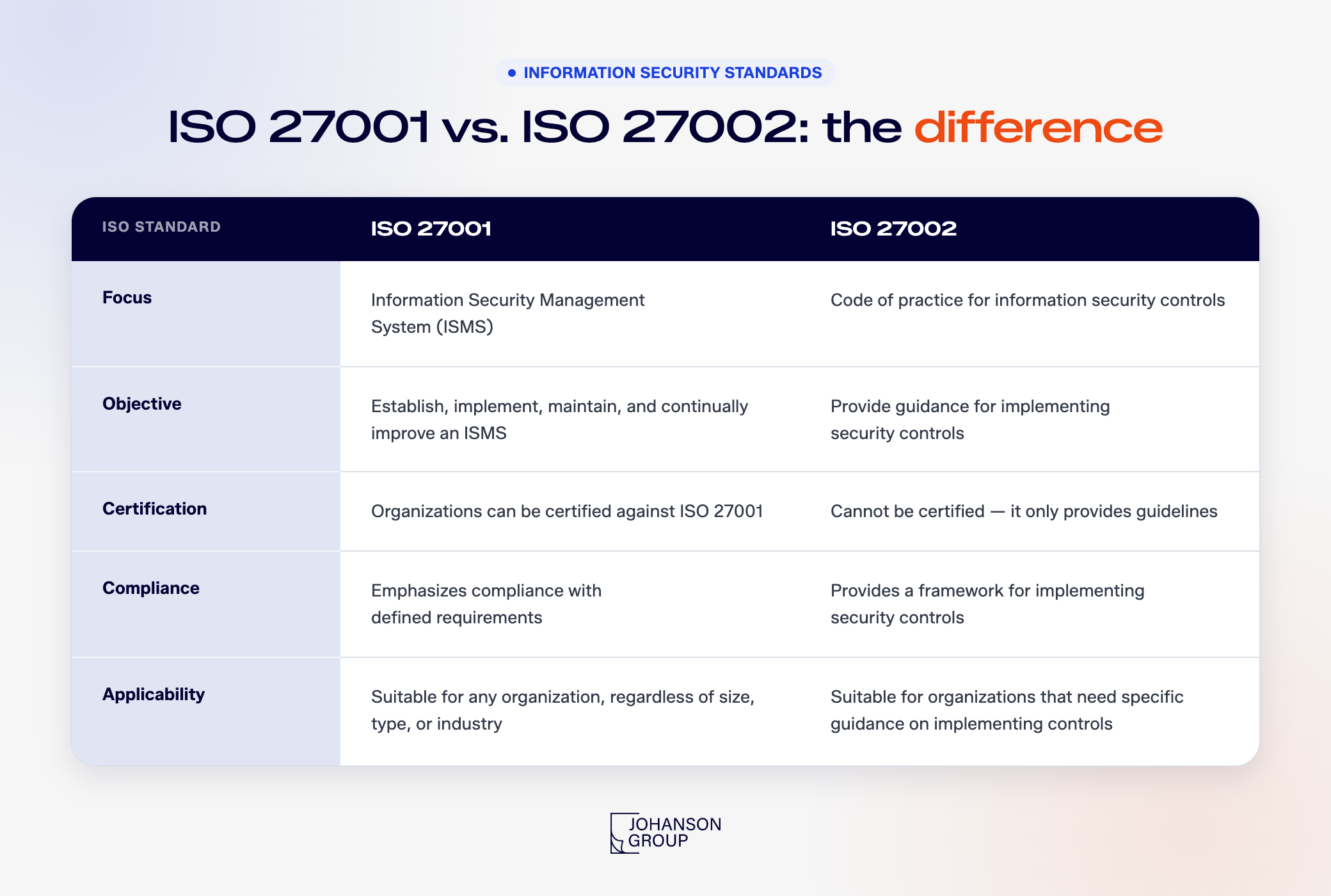
ISO/IEC 27001 is an international standard that outlines the specifications for establishing, implementing, maintaining, and continually improving an ISMS. This framework assists organizations in managing and protecting their valuable information assets, regardless of their size or industry.
What is ISO 27002?
Complementing ISO 27001, ISO 27002 provides guidelines and best practices for implementing information security controls. It offers a comprehensive set of security measures, ranging from policies and procedures to technical safeguards, designed to address various risks and vulnerabilities within an organization's information management processes.
What is the Difference Between ISO 27001 and ISO 27002?
While ISO 27001 focuses on the establishment and maintenance of an ISMS, ISO 27002 serves as a practical guide for implementing the controls necessary to mitigate information security risks. In essence, ISO 27001 lays down the framework, while ISO 27002 provides the detailed instructions for its implementation.
Why is ISO 27001 Important?
ISO 27001 is vital for organizations seeking to safeguard their sensitive information assets and uphold the trust of their stakeholders. Compliance with this standard not only enhances the security posture but also demonstrates a commitment to maintaining the confidentiality, integrity, and availability of information.
How Does ISO 27001 Work?
ISO 27001 operates on a systematic approach, starting with an initial risk assessment to identify and evaluate potential threats and vulnerabilities. Subsequently, organizations develop and implement a tailored set of security controls based on the identified risks, followed by regular monitoring, review, and continual improvement of the ISMS.
READ MORE: ISO 27001 Audits: Stage 1 vs. Stage 2
What is ISMS?
ISMS, or Information Security Management System, refers to the framework of policies, processes, procedures, and controls implemented to manage, monitor, and protect an organization's information assets effectively.
Why Do We Need ISMS?
ISMS is essential for organizations to proactively address the evolving landscape of cyber threats and regulatory requirements. By establishing a structured approach to information security management, ISMS helps mitigate risks, prevent data breaches, and ensure compliance with relevant laws and regulations.
What Are the Benefits of ISO 27001 Controls?
Implementing ISO 27001 controls offers a myriad of benefits, including enhanced risk management, improved operational efficiency, increased stakeholder confidence, and better regulatory compliance. Additionally, adherence to these controls fosters a culture of security awareness and accountability within the organization.
Johanson Group for ISO 27001 Certification
For organizations seeking ISO 27001 certification, partnering with a reputable certification body like Johanson Group can streamline the process and ensure compliance with international standards. With their expertise and experience in information security management, Johanson Group offers comprehensive support, from initial assessment to certification, enabling businesses to fortify their defenses and thrive in an increasingly digital world.
In summary, while ISO 27001 sets the foundation for establishing an ISMS, ISO 27002 provides the essential guidelines for implementing the necessary security controls. Together, they form a robust framework for organizations to safeguard their information assets and adapt to the evolving threat landscape. Embracing these standards not only strengthens security but also instills confidence among stakeholders, paving the way for sustainable growth and success.
SOC 2 Compliance: 5 Common Questions
SOC 2 Compliance: 5 Common Questions
SOC 2 compliance has emerged as a crucial standard for businesses handling sensitive information. But what exactly does SOC 2 entail? What benefits does it offer, and how can you determine if your organization is ready for it? Let's delve into these questions and demystify SOC 2 compliance.
1. What are the benefits of SOC 2?
SOC 2 compliance isn't just a checkbox exercise; it's a testament to your organization's commitment to security, privacy, and operational integrity. By adhering to SOC 2 standards, you signal to your clients and partners that their data is in safe hands. Here are some key benefits:
- Enhanced Trust: SOC 2 compliance demonstrates your dedication to protecting sensitive data, fostering trust with clients and stakeholders.
- Competitive Advantage: In today's data-driven world, SOC 2 compliance can be a differentiator, giving your business a competitive edge.
- Risk Mitigation: By implementing SOC 2 controls, you reduce the risk of data breaches and operational disruptions, safeguarding your reputation and bottom line.
2. What is the difference between Type 1 and Type 2?
Understanding the distinction between SOC 2 Type 1 and Type 2 reports is crucial for planning your compliance journey.
- Type 1: A Type 1 report evaluates the design and implementation of your controls at a specific point in time, providing a snapshot of your security posture.
- Type 2: In contrast, a Type 2 report assesses the effectiveness of these controls over a defined period (typically six months to a year), offering a more comprehensive view of your security practices.
Both reports play a vital role in demonstrating compliance, with Type 2 providing deeper insights into the operational effectiveness of your controls.
3. What does SOC 2 cover?
SOC 2 compliance encompasses a broad range of security, availability, processing integrity, confidentiality, and privacy principles. Here's a breakdown of what SOC 2 covers:
- System Monitoring: Continuous monitoring of systems to detect and respond to security incidents in real-time.
- Data Breach Alerts: Prompt notification and response procedures in the event of a data breach or security incident.
- Audit Procedures: Rigorous audit trails and procedures to ensure the integrity and accuracy of data handling processes.
By addressing these areas, SOC 2 helps organizations mitigate risks and uphold the highest standards of data security and privacy.
4. How long does it take to get a SOC 2 report?
The timeline for obtaining a SOC 2 report can vary depending on various factors, including the complexity of your organization's systems and processes, the readiness of your controls, and the chosen auditing firm. However, on average, the process typically takes between three to six months for a Type 1 report and six to twelve months for a Type 2 report.
It's essential to start early, conducting a thorough readiness assessment and implementing necessary controls to expedite the SOC 2 certification process.
READ MORE: Streamlining The SOC 2 Audit Process in 10 Steps
5. How do I know if I am ready for SOC 2?
Assessing your readiness for SOC 2 involves evaluating your organization's current security practices, policies, and procedures against SOC 2 requirements. Here are some indicators that you may be ready for SOC 2:
- Established Security Controls: You have robust security controls and processes in place to protect sensitive data and mitigate cybersecurity risks.
- Documented Policies: Your organization has documented policies and procedures covering security, privacy, and data protection practices.
- Commitment to Continuous Improvement: You demonstrate a commitment to ongoing monitoring, assessment, and improvement of your security posture.
Engaging with experienced cybersecurity professionals and conducting a readiness assessment can provide valuable insights into your preparedness for SOC 2 compliance.
SOC 2 compliance is not just a regulatory obligation but a strategic imperative for organizations seeking to safeguard sensitive data and maintain trust with their stakeholders. To embark on your SOC 2 compliance journey with confidence, consider partnering with a trusted provider like Johanson Group. With their expertise in SOC 2 compliance services, you can navigate the complexities of certification seamlessly, ensuring the security and integrity of your operations for years to come.

Who Needs ISO 27001 Certification?
Who Needs ISO 27001 Certification?
The protection of sensitive information has emerged as a critical imperative for organizations worldwide. With cyber threats becoming increasingly sophisticated, the need for robust information security measures has never been more pronounced. Enter ISO 27001 certification—a globally recognized standard that delineates best practices for establishing, implementing, maintaining, and continually improving an Information Security Management System (ISMS).
In this comprehensive guide, we delve deep into the realm of ISO 27001 certification, unraveling its intricacies, exploring its myriad benefits, and elucidating why it's an indispensable cornerstone for organizations seeking to fortify their security posture.
What is ISO 27001 Certification?
At its core, ISO 27001 certification serves as a testament to an organization's unwavering commitment to information security excellence. This certification provides a structured framework for identifying, assessing, and mitigating information security risks, thereby safeguarding the confidentiality, integrity, and availability of sensitive data.
By adhering to the stringent requirements outlined in ISO 27001, organizations can instill confidence among stakeholders, bolster their resilience against cyber threats, and demonstrate their dedication to maintaining the highest standards of information security.
Who Needs ISO 27001?
The applicability of ISO 27001 transcends industry boundaries, encompassing organizations of all sizes and sectors. Whether it's a small startup, a multinational corporation, or a government agency, any entity that handles sensitive information can benefit from ISO 27001 certification.
From financial institutions safeguarding transactional data to healthcare providers protecting patient records, the need for robust information security measures is ubiquitous. By obtaining ISO 27001 certification, organizations can proactively mitigate security risks, enhance their reputation, and gain a competitive edge in today's hyperconnected world.
Who Benefits from ISO 27001?
The benefits of ISO 27001 certification reverberate across various echelons of an organization and beyond:
- Executives and Management: Gain enhanced visibility into security risks and opportunities for improvement.
- IT Professionals: Leverage a structured framework for implementing and managing information security controls effectively.
- Customers and Stakeholders: Garner confidence in the organization's commitment to safeguarding sensitive information.
- Regulators and Compliance Bodies: Acknowledge adherence to internationally recognized security standards, facilitating regulatory compliance.
Which Industries Need ISO 27001 Certification?
While ISO 27001 is universally applicable, certain industries gravitate towards obtaining this certification due to the nature of their operations and the sensitivity of the data they handle. Industries that are inclined towards ISO 27001 certification include:
- Finance
- Healthcare
- Information Technology
- Telecommunications
However, in today's digital ecosystem, where data breaches can spell catastrophe for any organization, ISO 27001 is relevant across the spectrum.
8 Benefits of ISO 27001 Compliance:
- Boosting Customer Confidence:
- Demonstrates a commitment to safeguarding sensitive information, fostering trust among customers and stakeholders.
- Standing Out in the Market:
- Sets the organization apart by showcasing a proactive approach towards information security, enhancing its reputation in the market.
- Preventing Financial Losses:
- Mitigates the risk of data breaches and cyberattacks, thus averting potential financial losses associated with remediation, fines, and reputational damage.
- Meeting Legal Requirements:
- Ensures compliance with stringent data protection regulations such as GDPR, HIPAA, and CCPA, shielding the organization from legal repercussions.
- Compliance Readiness and Streamlining Audits:
- Provides a structured framework for managing information security, facilitating compliance readiness and simplifying audits and regulatory assessments.
- Strengthening Internal Security:
- Fosters a culture of security awareness and accountability, bolstering internal security mechanisms and minimizing the risk of insider threats.
- Aligning Objectives:
- Encourages alignment between business objectives and security goals, ensuring a holistic approach towards risk management and resource allocation.
- Peace of Mind:
- Offers invaluable peace of mind, knowing that robust security measures are in place to safeguard sensitive information, allowing organizations to focus on core business objectives.
Choose Johanson Group for ISO 27001 Certification
At Johanson Group, we recognize the paramount importance of information security. Our expert team is dedicated to guiding organizations on their journey towards ISO 27001 certification, providing tailored solutions to address their unique security challenges. By partnering with Johanson Group, organizations can fortify their defenses, instill trust among stakeholders, and embark on a trajectory of security excellence. Choose Johanson Group for ISO 27001 certification, and let's secure your organization's future together.
SOC for Cybersecurity vs. SOC 2: What’s the Difference?
SOC for Cybersecurity vs. SOC 2: What’s the Difference?
Cybersecurity breaches are an ever-present threat to organizations of all sizes. A Clark School study at the University of Maryland is one of the first to quantify the near-constant rate of hacker attacks of computers with Internet access— every 39 seconds on average, affecting one in three Americans every year.
In response to this growing concern, the American Institute of Certified Public Accountants (AICPA) has developed SOC (Service Organization Control) reports to assist organizations in achieving compliance and securing sensitive data. Two common types of SOC reports are SOC 1 and SOC 2, each serving distinct purposes within the realm of cybersecurity and compliance.
The Relationship Between SOC for Cybersecurity and SOC 2
While both SOC for Cybersecurity and SOC 2 are geared towards enhancing cybersecurity practices within organizations, they serve different purposes and cater to different audiences. SOC for Cybersecurity focuses specifically on an organization's cybersecurity risk management program, providing stakeholders with assurance regarding the effectiveness of these measures.
On the other hand, SOC 2 evaluates the design and effectiveness of controls relevant to security, availability, processing integrity, confidentiality, and privacy, with a broader scope encompassing overall service delivery.
READ MORE: The 5 Benefits of SOC 2 Reporting for Your Organization
Differences Between SOC for Cybersecurity and SOC 2
Scope: SOC for Cybersecurity assesses an organization's cybersecurity risk management program, including policies, procedures, and controls related to cybersecurity. SOC 2, however, evaluates controls relevant to security, availability, processing integrity, confidentiality, and privacy, with a focus on service delivery.
Control Criteria: SOC for Cybersecurity primarily follows the AICPA's cybersecurity risk management reporting framework, while SOC 2 adheres to predefined criteria based on the Trust Services Criteria (TSC) established by the AICPA.
Audience: SOC for Cybersecurity reports are intended for a broader range of stakeholders, including boards of directors, investors, and business partners, seeking assurance on an organization's cybersecurity posture. SOC 2 reports, on the other hand, are typically requested by customers and stakeholders concerned with data security and privacy in outsourced services.
Third-Party Risks: SOC for Cybersecurity evaluates an organization's ability to manage cybersecurity risks internally, whereas SOC 2 assesses the controls implemented by service organizations to mitigate risks associated with outsourced services.
Sensitive Information: SOC for Cybersecurity focuses on protecting sensitive information related to cybersecurity risks and threats, while SOC 2 evaluates controls related to the security, availability, processing integrity, confidentiality, and privacy of data processed by service organizations.
Check out these resources to help you get started on your SOC 2 audit:
- How to choose your risk advisory specialist for SOC 2 audits
- Your pre-audit checklist for SOC 2 audits and compliance
- SOC 2 compliance with your Customer Success Manager (CSM)
Improve Your Controls with Johanson Group
As organizations strive to enhance their cybersecurity posture and achieve compliance with industry standards, partnering with a trusted advisor like Johanson Group can provide invaluable support. With expertise in SOC attestation and cybersecurity risk management, Johanson Group offers comprehensive solutions tailored to your organization's specific needs. From conducting readiness assessments to implementing robust controls, Johanson Group is committed to helping you achieve SOC 2 attestation and bolster your cybersecurity defenses.
While SOC for Cybersecurity and SOC 2 both aim to strengthen cybersecurity practices within organizations, they serve distinct purposes and cater to different stakeholders. Understanding the differences between these two frameworks is essential for organizations seeking to enhance their cybersecurity posture and achieve compliance with industry standards. Partnering with a reputable firm like Johanson Group can streamline the attestation process and provide assurance to stakeholders regarding the effectiveness of your cybersecurity controls.
ISO 27001 for Small Businesses
ISO 27001 for Small Businesses
In an era where digital threats loom large, safeguarding sensitive information has become paramount for businesses of all sizes. Small businesses, in particular, can benefit significantly from implementing robust information security measures.
ISO 27001, an international standard for information security management, provides a comprehensive framework for protecting data assets. In this guide, we will explore the importance of ISO 27001 for small businesses, the industries that can benefit, the implementation process, the necessity of certification, and the associated costs.
The pervasive nature of cyber threats makes information security indispensable for small businesses. ISO 27001 serves as a comprehensive guide for identifying, managing, and mitigating information security risks. It ensures the confidentiality, integrity, and availability of crucial data, bolstering the resilience of small enterprises against potential threats. Implementing ISO 27001 fosters a culture of security, instilling confidence in clients and stakeholders about the small business's commitment to safeguarding sensitive information.
ISO 27001 is a versatile standard applicable to a wide range of industries. Small businesses operating in finance, healthcare, legal services, technology, Saas, and any sector dealing with sensitive information can benefit significantly. The standard is instrumental in protecting financial records, patient data, legal documents, and intellectual property. By obtaining ISO 27001 certification, small businesses enhance their credibility and gain a competitive advantage in industries where data security is paramount.
Implementing ISO 27001 involves a structured approach tailored to the specific needs of each small business. The process typically begins with a thorough risk assessment, identifying assets and potential vulnerabilities. Small businesses then develop information security policies, create an Information Security Management System (ISMS), and define roles and responsibilities. The establishment of controls and continuous monitoring ensures ongoing compliance and readiness to adapt to evolving threats.
While ISO 27001 certification is not mandatory, it offers several advantages for small businesses. Certification provides a tangible demonstration of a commitment to information security best practices. It can serve as a differentiator in the market, attracting clients who prioritize secure business partnerships. Additionally, some industries and clients may explicitly require ISO 27001 certification as a prerequisite for collaboration, making it a strategic investment for small businesses.
The cost of ISO 27001 certification for small businesses varies based on factors such as organizational size, complexity, and the chosen certification body. Costs may include employee training, consultancy fees for expert guidance, and charges associated with the certification audit. While the initial investment may seem significant, the long-term benefits, including improved security posture, reduced risks, and potential business expansion, justify the costs.
In conclusion, ISO 27001 is a valuable asset for small businesses seeking to fortify their information security practices. Beyond mere compliance, ISO 27001 fosters a proactive and resilient approach to cybersecurity. To embark on the journey of ISO 27001 certification, small businesses are encouraged to contact Johanson Group.
Our experienced professionals specialize in guiding organizations through the intricate process, ensuring a seamless and successful implementation of ISO 27001. Safeguard your digital future with Johanson Group – where security meets excellence. Contact us today to secure your small business against evolving digital threats.
Services


