



Reading a SOC 2 report can seem complex at first, but it's essential for assessing the security, availability, processing integrity, confidentiality, and privacy of a service provider's systems.
Reading a SOC 2 report can seem complex at first, but it's essential for assessing the security, availability, processing integrity, confidentiality, and privacy of a service provider's systems.
SOC 2 reports are often used to evaluate the controls and processes of technology service providers, like data centers, cloud providers, and software as a service (SaaS) companies. Here's a step-by-step guide on how to read a SOC 2 report:
Understand the Purpose of the Report:
SOC 2 reports are generated by a third-party auditor who evaluates the service provider's controls and processes in relation to the five trust principles mentioned above. These reports provide valuable information to clients and stakeholders about the security and reliability of the service provider's systems.
Determine the Type of SOC 2 Report:
There are two main types of SOC 2 reports: Type I and Type II. Type I reports focus on the design of controls at a specific point in time, while Type II reports cover the design and effectiveness of controls over a period of time (usually six months or more). Determine which type of report you're reviewing.
Review the Scope of the SOC 2 Report:
Understand the scope of the SOC 2 report. It should define the systems and processes that are being evaluated, as well as any limitations of the assessment.
Read the SOC 2 Auditor's Opinion:
Start by reading the auditor's opinion. This section will provide an overall assessment of the service provider's controls and processes. It will state whether the controls are suitably designed (for Type I) or designed and operating effectively (for Type II).

Review the Management's Assertion:
The management of the service provider will provide a statement asserting the accuracy and completeness of the information presented in the report. This is a critical section to understand the provider's commitment to their controls.
Examine the Description of Systems:
This section provides an overview of the service provider's systems and processes that were assessed. It includes details about the architecture, components, and technologies used.
Evaluate the Control Objectives and Activities:
This is the heart of the report. It describes the specific control objectives related to each of the trust principles and the corresponding control activities implemented by the service provider. It explains how the provider is meeting these objectives and securing its systems.
Review the Test Procedures:
In a Type II report, you'll find information about the tests performed by the auditor to evaluate the effectiveness of the controls. This might include details about sampling methods and evidence collected.
Analyze the Results and Findings:
If you're looking at a Type II report, you'll find the auditor's assessment of whether the controls were operating effectively. Any findings, exceptions, or deficiencies will be documented here. Understand the nature and severity of these findings.
Examine Additional Information:
Depending on the specific report, there might be additional sections providing context, background information, and details about the audit process.
Consider the Impact:
Interpret the findings in the context of your organization's needs. Consider whether any findings are significant enough to affect your decision to engage with the service provider. Keep in mind that some findings might be common or minor, while others could indicate larger security or reliability issues.
Consult with Experts (If Needed):
If you're not well-versed in understanding SOC 2 reports, consider consulting with experts who specialize in cybersecurity, compliance, or auditing. They can help you interpret the findings and their implications accurately.
Remember that SOC 2 reports can be complex, and understanding them thoroughly is crucial for making informed decisions about engaging with a service provider.
Contact Johanson Group today to learn more.


Streamlining The SOC 2 Audit Process in 10 Steps
Streamlining The SOC 2 Audit Process in 10 Steps
When clients approach audit firms regarding the SOC 2 Attestation process, they often find it daunting and overwhelming. SOC 2 audit firms should strive to simplify the process and instill confidence in their clients. Unfortunately, clients are often uninformed about the complexities of the SOC 2 auditing process.
At Johanson Group, LLC, we do things differently.
We believe in collaborating with our clients rather than excluding them. We ensure that our clients comprehend every step of the procedure, know their current position, and know the subsequent step to guarantee an effortless process and audit.
To provide clarity and simplicity, we have outlined the step-by-step process that our clients follow with Johanson Group.
Step 1: Sales Call
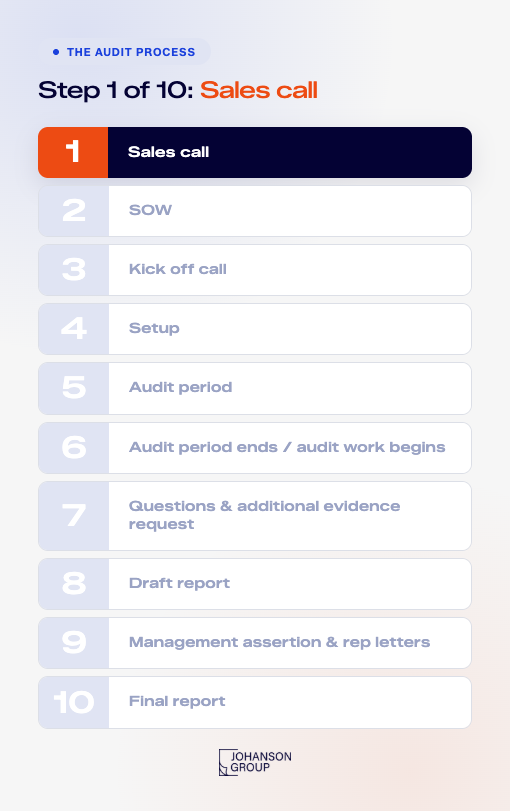
Meet with a sales team member to see if Johanson Group's services, approach, and price fit your needs. You can book a meeting with them here.
Step 2: Partner with Johanson Group by signing a Statement of Work
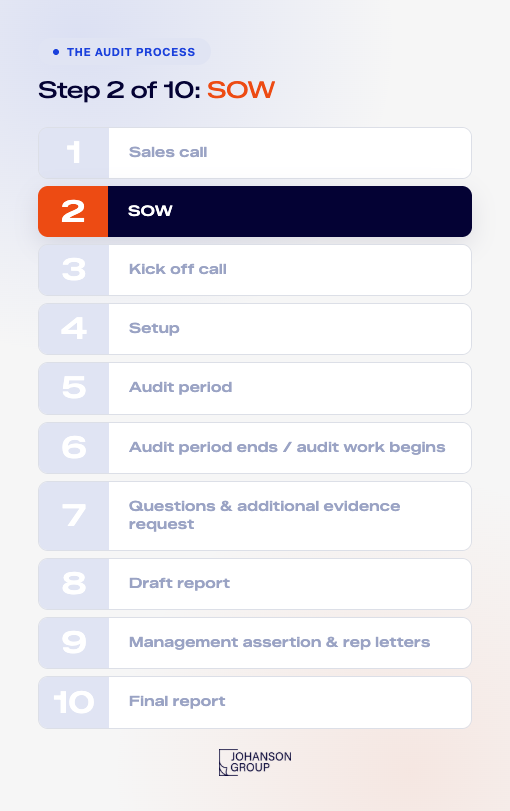
Once your organization has decided to move forward with Johanson Group, the next step in the SOC 2 audit process is the Statement of Work (SOW). We will send the SOW. Once signed, we are ready to start the process of your SOC 2 compliance audit. If your organization would like a letter of engagement to share with your customers, we would happily provide one.
Step 3: Kick-off call
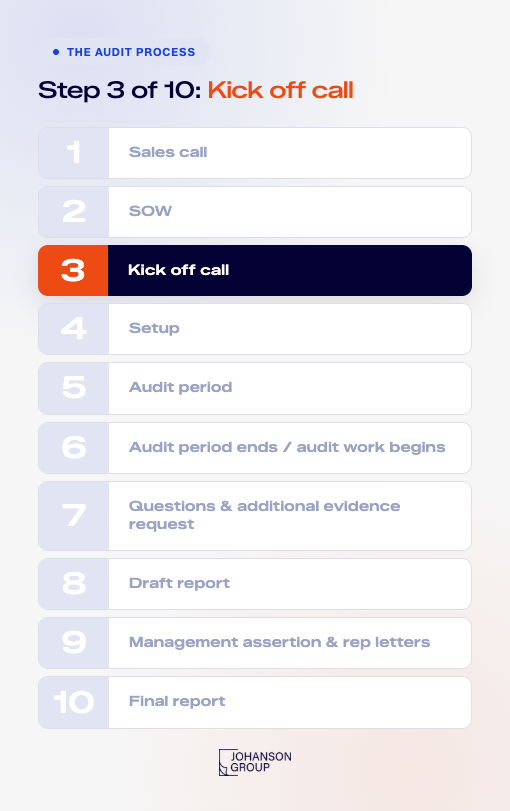
The next step in your SOC 2 audit process is the kick-off call. A member of our customer success team will reach out to you to arrange a kick-off meeting where we can delve into the audit process in greater depth.
During this meeting, they will be more than happy to address any questions or concerns you might have and establish a cadence for follow-up communications.
Step 4: Prepare your organization for the SOC 2 compliance audit internally
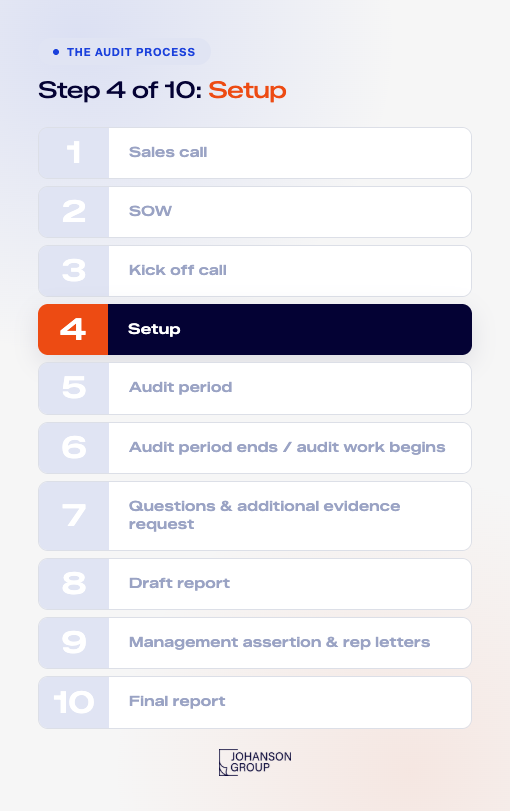
In this phase of the SOC 2 audit process, you will be working on configuring the platforms you use for data security or other information systems software.
Your main tasks in this step involve:
- Integrating these systems
- Creating policies
- Identifying and implementing controls to ensure data security
If you have any questions or need assistance during this process, don't hesitate to contact your Customer Success Manager (CSM).
After setting everything up, your primary focus should be ensuring that your organization adheres to the established policies and controls to achieve compliance. Please let your CSM know when you want to start the audit. Setting up your controls can take anywhere from 14 days to 3-4 months; ultimately, it's at your own pace, but our team is always on hand to support you in your SOC 2 goals and journey.
Step 5: The SOC 2 Audit Process Begins
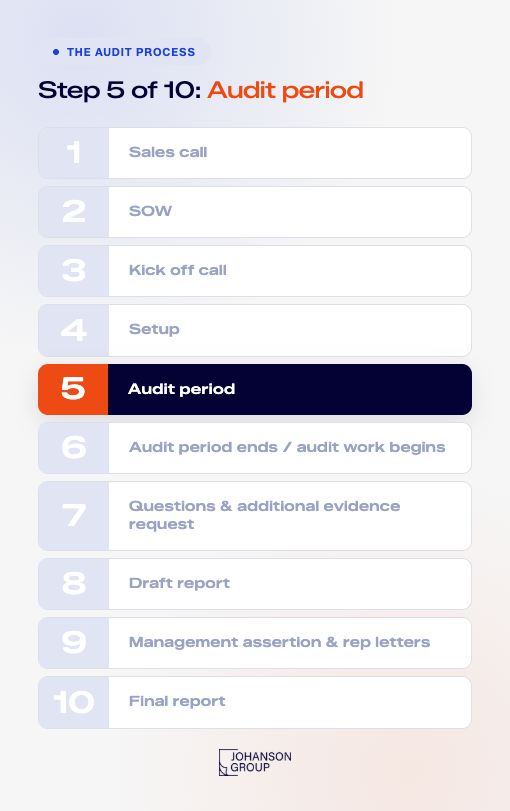
After finishing all the setup and putting the controls in place, your organization will start the audit period. During this time, you must monitor the controls to ensure they are within the time limits your organization has set (called SLAs). f you are using a readiness platform, we recommend logging in to your platform every day to check for any new issues that might arise.
The shortest audit period for a SOC 2 Type II is three (3) months, while the subsequent audit periods afterwards usually last twelve (12) months.
READ MORE: SOC 2 Frequency: What You Should Know
Step 6: Audit period ends/ audit work begins

Once the audit period is over, Johanson Group will begin our audit procedures. Our team will access the platform or provide evidence and promptly download all policies and evidence required. We will check if controls are working well and then review them to ensure they worked well throughout the audit.
Step 6 is mandatory and typically takes approximately 2-3 weeks.
Step 7: Follow-up
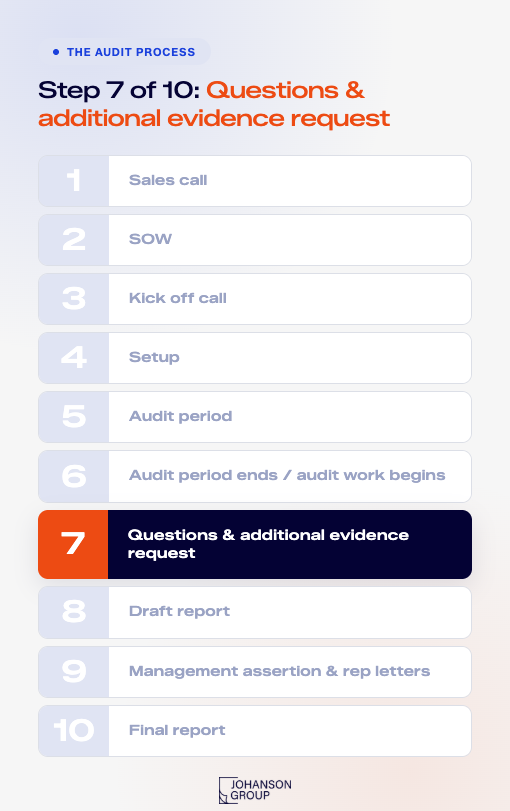
After our review process, we may contact you with follow-up questions or requests for additional evidence.
Receiving a notification like this doesn't necessarily indicate failure on your part; perhaps certain items need to be correctly uploaded onto the platform or provided to the audit team.
You can upload the evidence again on the platform or send it directly to us if necessary.
Usually, this process takes less than a week, but the exact timeframe may be affected by how quickly you respond.
Step 8: Our team will draft your SOC 2 audit report
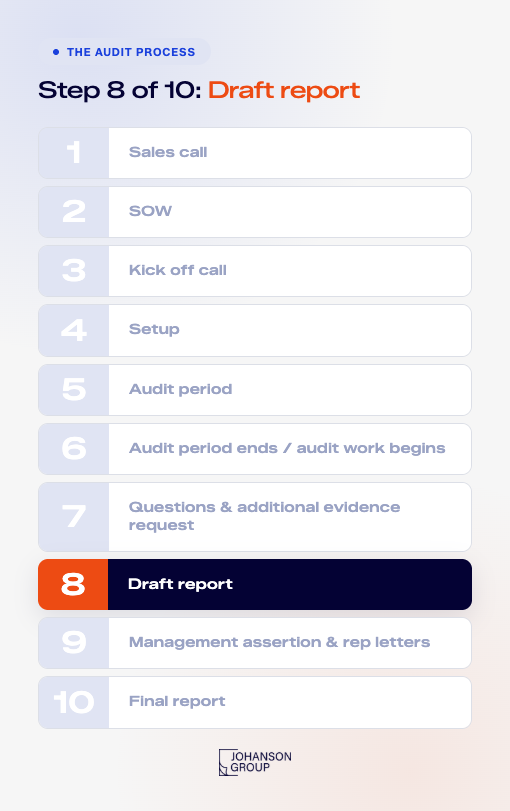
Once you have answered all questions and Johanson Group has reviewed the additional evidence, we will send you a draft report for your review. You must thoroughly read the report to verify that all dates and trust service categories are accurate and there are no surprises.
Drafting the report usually takes 1-2 days. Your review of the draft report occurs at your own pace.
Step 9: Sign the Management Assertion and Representation Letters
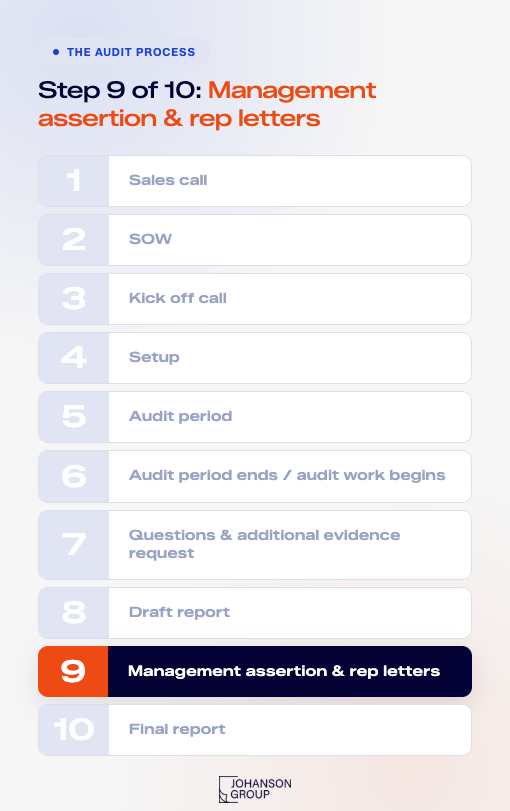
In this step of the SOC 2 audit process, once you have approved the draft, we will send over the Management Assertion and Representation letters for signature via DocuSign. These documents confirm that the management effectively designed and implemented controls that continued to operate efficiently during the audit period.
Step 10: You will receive the Final SOC 2 Audit report
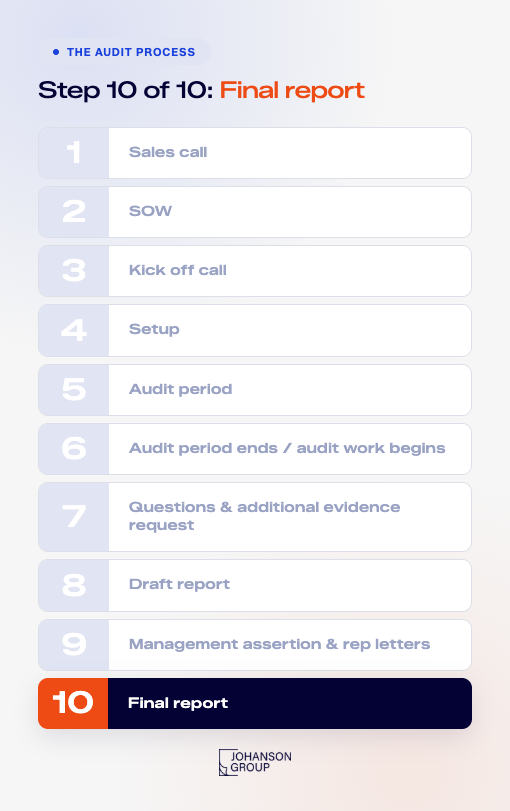
Once the management assertion and representation letters are signed, Johanson Group will do one final review before sending over the report. This process usually takes 3-5 days.
Johanson Group’s Transparent SOC 2 Audit Process
Navigating the SOC 2 audit process can be daunting for many organizations, often needing more communication from audit firms to make sure they are going in the right direction. At Johanson Group, we are committed to changing this narrative and empowering our clients to understand each step along their SOC 2 journey clearly.
From the initial sales call to the final report, we prioritize transparency and seamless communication to ensure a smooth and successful audit. Our dedicated customer success team will guide you through the setup phase, ensuring your policies and controls are in place and making sure you are in a good position prior to starting the audit period.
Throughout the audit period, we will support you, ensuring timely resolution of any questions that may arise. From start to finish, our process is designed to help produce a report that aligns with your expectations and validates all your hard work and security posture.
With Johanson Group, you can confidently provide Management Assertion and Representation letters, affirming the suitability and effectiveness of your controls throughout the audit period. Finally, you can confidently share your SOC 2 report with current and prospective clients to let them know of your dedication to keeping you and their data secure.
Make your SOC 2 journey a seamless one with Johanson Group by your side. Let's get started on securing your business today!
What Is Required for a Successful SOC 2 Risk Assessment?
What Is Required for a Successful SOC 2 Risk Assessment?
You’ve done your research, know what SOC 2 is, and how it can benefit your organization. But you still have some questions about the process. In this article, we will dive into the key components of a comprehensive SOC 2 risk assessment and steps to ensure an effective process.
Key Components of a Comprehensive SOC 2 Risk Assessment
Risk assessments involve key elements to ensure organizations have thoroughly identified, evaluated and addressed potential risks to the Trust Service Criteria Categories. The following are components of a SOC 2 assessment are:
- Identify Relevant Trust Service Categories
- Defined by SOC 2, TSC encompasses Security, Availability, Processing, Integrity, Confidentiality, and Privacy. A tailored risk assessment means selecting which categories apply to the organization based on its operational goals and system functionalities. For example, a company that provides SaaS and deals with sensitive customer information will focus heavily on on Security and Confidentiality
- Asset Inventory & Classification
- Organizations must identify and categorize assets that are critical to their operations. These can include anything from physical devices, softwares, and data bases to personnel and processes.
- Threat Landscape Analysis
- An in-depth analysis of potential threats is a vital part of the assessment. Threats can range from external threats, such as fraud and cyber attacks, to internal risks like system malfunctions and employee error. It is also important to examine past incidents and industry specific risks to enhance the accuracy of the analysis.
- Risk-Based Prioritization
- After risks are identified and analyzed, the next step is to prioritize them based on factors such as likelihood and severity. Using standardized risk evaluation frameworks will allow you to concentrate resources on mitigating the most significant risks first.
- Control Effectiveness Evaluation
- Controls that are already in place should be evaluated to determine their capability to mitigate identified risks. These controls can include technical safeguards like access restrictions, procedural controls like data encryption policies, and organizational measures like employee training.
- Compliance Mapping
- The risk assessment must align with the SOC 2 framework by mapping relevant risks to specific criteria within the Trust Service Principles. This will ensure all risks are properly identified and meet compliance requirements.
- Documentation Review & Maintenance
- Proper documentation is extremely important. Risk findings, evidence, stakeholder decisions, and evaluation criteria must be recorded for reference and audit purposes. Systems evolve and risks change, which is why it’s important to regularly review and update documentation.
An effective SOC 2 risk assessment is more than a checkbox-its the foundation of your compliance program. By taking a structured approach you will not only be well-prepared for your audit, but you’ll also build a stronger security posture that will benefit your organization in the long run.
If you’re ready to begin your SOC 2 journey or want expert guidance through your risk assessment and audit, contact our team today!
Services


