


The Importance of Regular Security Audits for Your Organization

Cyber threats are evolving rapidly, and even the smallest vulnerability can be exploited, leading to severe consequences. Regular security audits are essential to ensuring your organization’s defenses are up to the challenge. These audits not only help you identify weaknesses but also ensure compliance with regulatory requirements, build customer trust, and protect against financial loss.
The security of your organization’s data is more critical than ever. Cyber threats are evolving rapidly, and even the smallest vulnerability can be exploited, leading to severe consequences. Regular security audits are essential to ensuring your organization’s defenses are up to the challenge. These audits not only help you identify weaknesses but also ensure compliance with regulatory requirements, build customer trust, and protect against financial loss.
What is a Security Audit?
A security audit is a comprehensive evaluation of your organization’s information systems to assess the effectiveness of your security measures. It involves reviewing policies, procedures, and technical controls to identify potential vulnerabilities and ensure that your organization is compliant with relevant security standards and regulations. Security audits are crucial for detecting weaknesses before they can be exploited by malicious actors.
READ MORE: IT Audit Checks: What You Need To Know
The Importance of Security Audits
1. Identifying Vulnerabilities Regular security audits are your first line of defense against cyber threats. By identifying vulnerabilities in your systems, you can take proactive measures to address them before they are exploited. This helps in mitigating risks and protecting your organization’s sensitive data.
2. Ensuring Regulatory Compliance Many industries are subject to strict regulatory requirements concerning data security. Regular security audits ensure that your organization remains compliant with these regulations, avoiding costly fines and legal issues. Compliance with standards like GDPR, HIPAA, and PCI DSS is not just a legal obligation but also a critical factor in maintaining your organization’s reputation.
3. Increasing Customer Trust Customers are increasingly concerned about how their data is handled. Regular security audits demonstrate your commitment to protecting their information, which can significantly boost customer trust and loyalty. A strong security posture is a competitive advantage that can set your organization apart in the marketplace.
4. Preventing Financial Loss The financial impact of a data breach can be devastating, ranging from lost revenue to legal costs and reputational damage. By conducting regular security audits, you can prevent these financial losses by identifying and addressing vulnerabilities before they lead to a breach.
Steps on How to Implement Regular Security Audits
- Define Objectives: Clearly outline the goals of your security audit, whether it’s compliance, vulnerability assessment, or overall security posture evaluation.
- Choose the Right Framework: Select a security framework that aligns with your organization’s industry and compliance needs (e.g., SOC, ISO 27001, PCI DSS).
- Conduct a Risk Assessment: Identify potential risks to your information systems and prioritize them based on the likelihood and impact of their occurrence.
- Review Security Policies: Ensure that your organization’s security policies are up-to-date and reflect current best practices.
- Test Technical Controls: Conduct thorough testing of your organization’s technical controls, such as firewalls, encryption, and access controls.
- Report Findings: Document the results of your audit, including identified vulnerabilities and recommended remediation steps.
- Implement Remediation: Address the vulnerabilities identified during the audit and monitor their resolution.
- Schedule Follow-Up Audits: Regular audits should be an ongoing process, not a one-time event. Schedule follow-ups to ensure continued compliance and security.
Types of Security Audits
1. SOC (System and Organization Controls) SOC audits are designed to assess an organization’s controls over financial reporting, data privacy, and security. SOC 1 audits focus on financial controls, while SOC 2 and SOC 3 audits evaluate controls related to security, availability, processing integrity, confidentiality, and privacy.
2. ISO 27001 ISO 27001 is a widely recognized standard for information security management systems (ISMS). It provides a framework for managing sensitive company information to remain secure. This standard is suitable for organizations of all sizes across various industries.
3. ISO 27017/18 These standards extend ISO 27001 by providing additional guidelines for cloud security (ISO 27017) and the protection of personal data in the cloud (ISO 27018). They are essential for organizations that rely on cloud services to manage and store data.
4. ISO 42001 ISO 42001 is a new international standard (published in late 2023) that provides a framework for organizations to establish, implement, maintain, and continually improve an Artificial Intelligence Management System (AIMS). Essentially, it's about ensuring the responsible development and use of AI systems
5. HIPAA (Health Insurance Portability and Accountability Act) HIPAA audits are crucial for organizations that handle protected health information (PHI). They ensure that healthcare providers, insurers, and other entities comply with stringent data privacy and security regulations to protect patient information.
6. PCI DSS (Payment Card Industry Data Security Standard) PCI DSS audits are essential for any organization that processes, stores, or transmits credit card information. Compliance with PCI DSS helps protect cardholder data and reduce the risk of data breaches.
7. GDPR (General Data Protection Regulation) GDPR audits are vital for organizations that handle the personal data of EU citizens. These audits ensure compliance with stringent data protection regulations designed to safeguard individuals’ privacy rights.
8. NIST (National Institute of Standards and Technology) NIST provides a cybersecurity framework that helps organizations manage and reduce cybersecurity risk. It is widely used by government agencies and private sector companies in the U.S.
Choose Johanson Group for All Security Audit Needs
Regular security audits are essential to safeguarding your organization’s data, ensuring compliance, and building trust with your customers. At Johanson Group, we specialize in conducting thorough and effective security audits tailored to your organization’s needs. Whether you require SOC, ISO, HIPAA, PCI DSS, GDPR, or NIST audits, our expert team is here to help. Protect your organization with Johanson Group—your trusted partner in security and compliance.


SOC 2 Compliance: 5 Common Questions
SOC 2 Compliance: 5 Common Questions
SOC 2 compliance has emerged as a crucial standard for businesses handling sensitive information. But what exactly does SOC 2 entail? What benefits does it offer, and how can you determine if your organization is ready for it? Let's delve into these questions and demystify SOC 2 compliance.
1. What are the benefits of SOC 2?
SOC 2 compliance isn't just a checkbox exercise; it's a testament to your organization's commitment to security, privacy, and operational integrity. By adhering to SOC 2 standards, you signal to your clients and partners that their data is in safe hands. Here are some key benefits:
- Enhanced Trust: SOC 2 compliance demonstrates your dedication to protecting sensitive data, fostering trust with clients and stakeholders.
- Competitive Advantage: In today's data-driven world, SOC 2 compliance can be a differentiator, giving your business a competitive edge.
- Risk Mitigation: By implementing SOC 2 controls, you reduce the risk of data breaches and operational disruptions, safeguarding your reputation and bottom line.
2. What is the difference between Type 1 and Type 2?
Understanding the distinction between SOC 2 Type 1 and Type 2 reports is crucial for planning your compliance journey.
- Type 1: A Type 1 report evaluates the design and implementation of your controls at a specific point in time, providing a snapshot of your security posture.
- Type 2: In contrast, a Type 2 report assesses the effectiveness of these controls over a defined period (typically six months to a year), offering a more comprehensive view of your security practices.
Both reports play a vital role in demonstrating compliance, with Type 2 providing deeper insights into the operational effectiveness of your controls.
3. What does SOC 2 cover?
SOC 2 compliance encompasses a broad range of security, availability, processing integrity, confidentiality, and privacy principles. Here's a breakdown of what SOC 2 covers:
- System Monitoring: Continuous monitoring of systems to detect and respond to security incidents in real-time.
- Data Breach Alerts: Prompt notification and response procedures in the event of a data breach or security incident.
- Audit Procedures: Rigorous audit trails and procedures to ensure the integrity and accuracy of data handling processes.
By addressing these areas, SOC 2 helps organizations mitigate risks and uphold the highest standards of data security and privacy.
4. How long does it take to get a SOC 2 report?
The timeline for obtaining a SOC 2 report can vary depending on various factors, including the complexity of your organization's systems and processes, the readiness of your controls, and the chosen auditing firm. However, on average, the process typically takes between three to six months for a Type 1 report and six to twelve months for a Type 2 report.
It's essential to start early, conducting a thorough readiness assessment and implementing necessary controls to expedite the SOC 2 certification process.
READ MORE: Streamlining The SOC 2 Audit Process in 10 Steps
5. How do I know if I am ready for SOC 2?
Assessing your readiness for SOC 2 involves evaluating your organization's current security practices, policies, and procedures against SOC 2 requirements. Here are some indicators that you may be ready for SOC 2:
- Established Security Controls: You have robust security controls and processes in place to protect sensitive data and mitigate cybersecurity risks.
- Documented Policies: Your organization has documented policies and procedures covering security, privacy, and data protection practices.
- Commitment to Continuous Improvement: You demonstrate a commitment to ongoing monitoring, assessment, and improvement of your security posture.
Engaging with experienced cybersecurity professionals and conducting a readiness assessment can provide valuable insights into your preparedness for SOC 2 compliance.
SOC 2 compliance is not just a regulatory obligation but a strategic imperative for organizations seeking to safeguard sensitive data and maintain trust with their stakeholders. To embark on your SOC 2 compliance journey with confidence, consider partnering with a trusted provider like Johanson Group. With their expertise in SOC 2 compliance services, you can navigate the complexities of certification seamlessly, ensuring the security and integrity of your operations for years to come.
CCPA vs GDPR: Navigating Privacy Regulations
CCPA vs GDPR: Navigating Privacy Regulations
Governments worldwide have responded by enacting legislation to protect individuals' personal data. Two significant pieces of legislation leading this charge are the General Data Protection Regulation (GDPR) in the European Union and the California Consumer Privacy Act (CCPA) in the United States. So let's look into CCPA vs. GDPR, the similarities and differences between the two.
A Brief Summary of GDPR:
- EU law since 2018, protecting EU residents' data.
- Applies globally to organizations handling EU residents' data.
- Defines data subject rights, lawful processing, and accountability.
- Imposes fines up to 4% of global turnover for breaches.
More about GDPR:
- What is GDPR? - The Ultimate Guide to GDPR
- GDPR.EU - Official European Union site
A Brief Summary of CCPA:
- California law since 2020, enhancing residents' privacy.
- Applies to businesses meeting specific revenue or data criteria.
- Grants consumers rights to know, opt-out, and non-discrimination.
- Fines up to $7,500 per violation for non-compliance.
More about CCPA:
- CCPA Civil Code - Official code on California state legislation information site
- CCPA Overview - Official overview
Definition of Personal Data
CCPA Definition of Personal Information:
According to the CCPA, personal information refers to information that identifies, relates to, describes, is capable of being associated with, or could reasonably be linked, directly or indirectly, with a particular consumer or household. This includes, but is not limited to, identifiers such as a real name, alias, postal address, unique personal identifier, online identifier, Internet Protocol address, email address, account name, social security number, driver's license number, passport number, or other similar identifiers.
CCPA also considers personal information to include categories of information such as biometric information, geolocation data, professional or employment-related information, education information, and inferences drawn from other personal information that may create a profile about a consumer.
GDPR Definition of Personal Data:
Under the GDPR, personal data is defined as any information relating to an identified or identifiable natural person ('data subject'). An identifiable natural person is one who can be identified, directly or indirectly, in particular by reference to an identifier such as a name, an identification number, location data, an online identifier, or to one or more factors specific to the physical, physiological, genetic, mental, economic, cultural, or social identity of that natural person.
GDPR's definition of personal data is broad and encompasses any information that can be linked to an individual, including basic identity information, web data, biometric data, health and genetic data, cultural or social identity information, and more.
What Rights Do the CCPA and GDPR Give People?
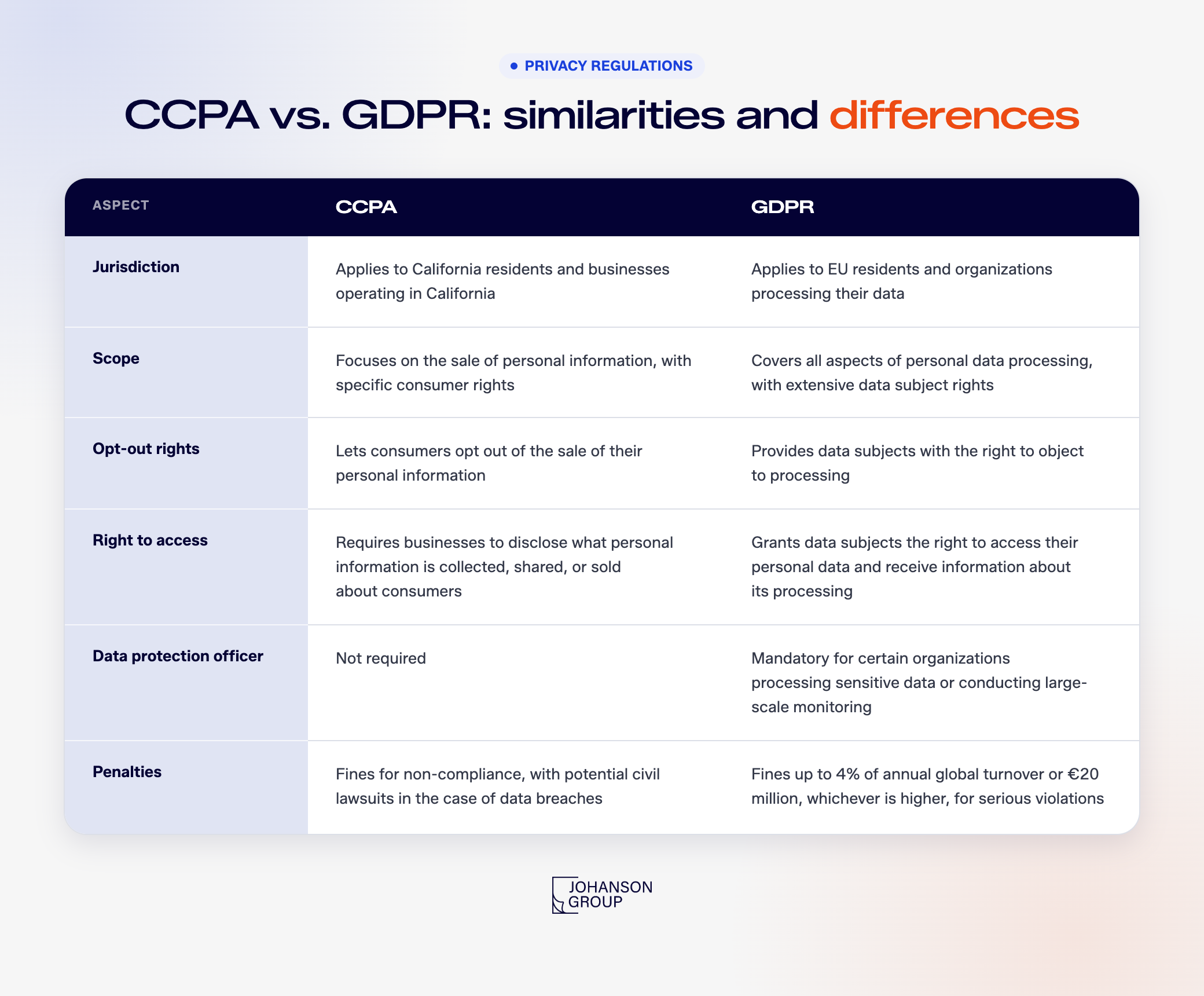
Both the California Consumer Privacy Act (CCPA) and the General Data Protection Regulation (GDPR) grant individuals certain rights regarding their personal data. Here's a comparison of the rights provided by each:
Rights under CCPA (California Consumer Privacy Act):
- Right to Know: Individuals have the right to know what personal information is being collected about them, the sources of the information, the purpose of collection, and whether it is being sold or disclosed.
- Right to Opt-Out: Individuals have the right to opt-out of the sale of their personal information to third parties. Businesses must provide a clear and conspicuous link on their websites titled "Do Not Sell My Personal Information" to enable this right.
- Right to Access: Individuals have the right to request access to the specific pieces of personal information that businesses have collected about them.
- Right to Deletion: Individuals have the right to request that businesses delete their personal information, subject to certain exceptions.
- Right to Non-Discrimination: Individuals have the right not to be discriminated against for exercising their privacy rights under the CCPA, including through denial of goods or services, charging different prices, or providing a different quality of service.
Rights under GDPR (General Data Protection Regulation):
- Right to Access: Data subjects have the right to obtain confirmation from the data controller as to whether personal data concerning them is being processed, and if so, access to that data.
- Right to Rectification: Data subjects have the right to request the correction of inaccurate or incomplete personal data.
- Right to Erasure ("Right to be Forgotten"): Data subjects have the right to request the deletion of their personal data under certain circumstances, such as when the data is no longer necessary for the purposes for which it was collected or if the data was unlawfully processed.
- Right to Restriction of Processing: Data subjects have the right to request the restriction of processing of their personal data under certain circumstances, such as when the accuracy of the data is contested or the processing is unlawful.
- Right to Data Portability: Data subjects have the right to receive their personal data in a structured, commonly used, and machine-readable format and have the right to transmit that data to another controller.
- Right to Object: Data subjects have the right to object to the processing of their personal data, including for direct marketing purposes, on grounds relating to their particular situation.
- Rights related to Automated Decision Making and Profiling: Data subjects have the right not to be subject to a decision based solely on automated processing, including profiling, which produces legal effects concerning them or similarly significantly affects them.
Navigating the complexities of privacy regulations like CCPA and GDPR is essential for businesses aiming to build trust with consumers and avoid costly penalties. While both regulations share common principles, understanding their unique requirements is crucial for compliance. By prioritizing data protection and adopting robust privacy practices, businesses can navigate the intricacies of CCPA and GDPR while safeguarding individuals' rights to privacy.

Key Differences Between ISO 27001 and 27002
Streamline your payment security controls to protect transactions and maintain merchant trust.
Information security is a pressing concern for organizations.
Cyber threats are on the rise, and more personal information falls into the wrong hands every day.
That's why organizations with an ISMS (information security management system) rely on standards in a set of series called the ISO 27000 series published by the International Organization for Standardization (ISO) and the International Electrotechnical Commission (IEC). Within the ISO 2700 series are the ISO 27001 and 27002.
This article will discuss some key differences between ISO 27001 and 27002 and how each standard helps protect an organization's data from cyber threats.
But before we go into the differences, it's important to note that the ISO 27000 series standards focus on information security. They do not include physical safety, personnel security, or software development requirements.
ISO/IEC 27001 and 27002, what's the difference?
While seemingly similar, the two are just as different. If combined into one singular standard, the compliance criteria would be too complicated to implement and use practically.
To keep it simple, ISO 27001 is a recognized standard for an organization's ISMS. Think of it as a checklist of everything you must complete to receive compliance certification.
ISO 27002 references cyber security, privacy protection, information security, and risk assessment rules.
So, the key differences between the two are:
- Details: ISO 27001 is broad regarding ISMS implementation controls and rules, while ISO 27002 offers detailed recommendations for compliance criteria.
- Applicability: Every ISMS organization and business isn't the same; therefore, following ALL of the recommendations listed in ISO 27002 wouldn't be realistic or needed. ISO 27001 requires organizations must undergo a risk assessment to identify risks but doesn't specify which ones. That is where ISO 27002 comes in handy. Use it as a guide for compliance to prioritize potential risks for your organization.
- Certification: Your organization can only be certified in compliance with ISO 27001 standards. Becoming certified means your organization is fully compliant in your efforts to manage confidential data and information–both your employees and your customers.
Looking for ISO 27001 Compliance Certification? Start now.
What is the benefit of gaining ISO 27001 compliance certification?
ISO 27001 is considered the gold standard for information security management.
It helps organizations implement a system of internal controls to control and monitor their information security risks.
The goal of ISO 27001 is to ensure that an organization maintains a high level of protection for its customers, business partners, employees, and suppliers by implementing an effective ISMS (Information Security Management System).
Organizations can meet this goal by complying with the standards outlined in ISO 27001/27002:
- Risk assessment
- Asset classification and identification
- Control implementation and maintenance
While it's true that you can implement an effective information security program without certification, it's highly recommended to do so because most top-tier customers require certification before they'll consider doing business with you.
This requirement makes sense when you consider that any company possessing sensitive personal or financial data would want to know that their provider has taken all necessary precautions to safeguard this information against cyber attacks. A certificate of ISO 27001 compliance will help ensure this protection.
Examples of how ISO 27001 and ISO 2007 are different:
- The focus of the standards:
The focus of both standards is on information security management, but they take different approaches.
ISO 27001 focuses on information security management and is a generic standard, meaning that the criteria within ISO 27001 can apply to any organization regardless of its sector or industry.
ISO 27002 focuses on data security and is specific; it provides guidance for implementing specific controls within an organization's IT infrastructure (e.g., firewalls).
An organization must determine what type of system or system components will be covered by this standard. For example, a financial institution would focus on entirely different control standards to comply with than a healthcare organization would.
- Process vs. implementation requirements:
In addition to addressing different organizational needs based on sector and industry type, these standards also differ in process requirements versus implementation requirements—that is, how they handle each step required during your risk management program's lifecycle.
Both standards include sections dedicated solely to defining policies explicitly related to risk assessment (ISO/IEC 27000 - 4) and how to implement the suggested measures into daily operations, such as incident response plans (ISO 14701).
Why you need a CPA firm to help your organization with your ISO 27001 or ISO 27002
When managing ISO 27001 or ISO 27002, you need a CPA firm to help your organization with the following:
- A plan:
A solid plan aligned with your business goals and objectives will be essential to ensure success. You will also want to ensure that all key stakeholders are involved in developing this plan.
- Processes and procedures:
Once you have created your plan, it is crucial to define how you will implement it within your organization so everyone knows what's expected of them when carrying out their responsibilities as needed throughout each stage of the ISMS life cycle.
- Knowing the right tools to use for your specific industry and organization:
For example, if your organization is sharing sensitive data across different departments, you will probably need encryption technology like passwords and biometrics authentication systems (fingerprint readers). An experienced CPA in ISO 27001/27002 compliance can suggest the right tools to help you meet compliance criteria.
Information security is laudable. It needs to be done right to make sure that it is effective.
To recap: The difference between 27001 and 27002 is that they both focus on information security but differ in how they go about it.
ISO 27001 focuses more on the processes of an organization, while ISO 27002 focuses more on the products or services that an organization provides.
The best way to protect yourself from cyberattacks is by having a team of professionals who understand both standards to help implement them correctly for your business needs.
Ready to get ISO 27001 certified? Contact Johanson Group today to get started.
Services


